Build the foundation
for Somali speech AI.
Give developers the Somali datasets, speech models, evaluation tools and documentation they need to build AI that understands and speaks Somali naturally. QaamuusAI provides the foundation; developers build the applications.
A shared foundation for language and technology.
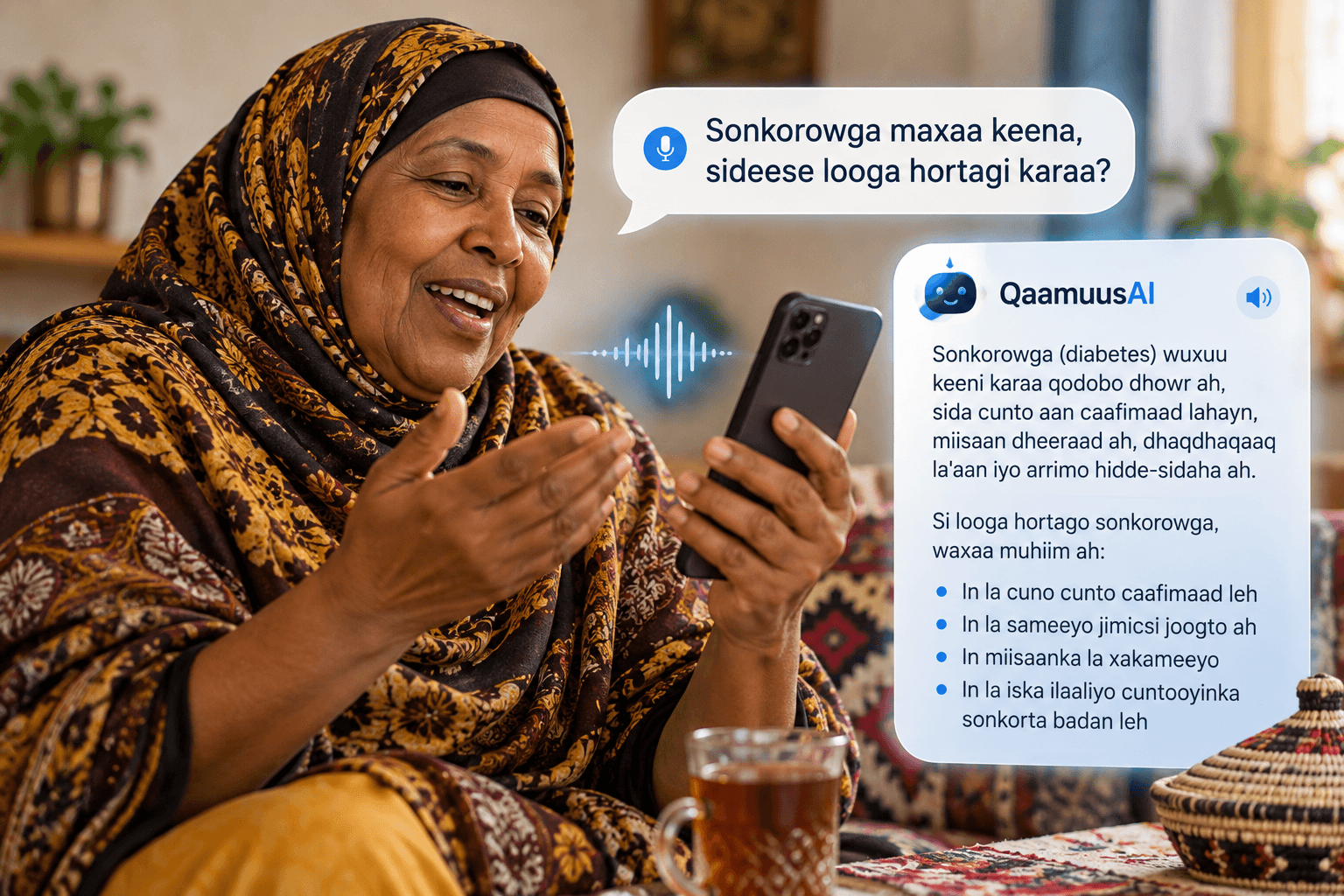
QaamuusAI is building a shared foundation for Somali language technology: reviewed text, consented speech recordings, accurate transcripts, models and developer tools. Developers could use these resources to train or adapt models and build voice assistants, learning tools, translation services and accessible applications. Our long-term ambition is natural Somali voice interaction, with dialect coverage and quality tested by Somali speakers.
Three capabilities developers can connect.
A spoken conversation combines different models. Developers can choose and connect these capabilities to suit their own applications.
Understand speech
Speech recognition turns recorded or live Somali speech into text. Checked recordings and transcripts support training and evaluation.
Work with language
Language models generate text from learned patterns, one token at a time. Reviewed Somali text and terminology can support adaptation and evaluation.
Generate speech
Speech generation turns text into spoken Somali. Voice development needs suitable recordings and explicit permission for the intended synthetic voice use.
The ambition is clear, natural Somali speech. Accuracy, naturalness and dialect coverage must be measured; fluent output alone does not establish quality. Learn how language models work
What we aim to give developers
- Language datasets: reviewed text, terminology, grammar, sources and licences.
- Speech datasets: consented audio, checked transcripts and dialect metadata.
- Models: evaluated speech recognition, speech generation and language model releases.
- Training tools: reproducible examples for training and adapting models.
- Benchmarks: separate evaluation sets, documented metrics and known limitations.
- Integration tools: APIs, SDKs and practical documentation where useful.
Four steps toward tools developers can use.
These are proposed milestones. Dates and commitments will be agreed once the team, access and budget are confirmed.
- 1
Build the language and data foundation
A reliable contributor platform and reviewed textComplete accounts, invitations, permissions and backups. Agree on dataset licences, consent, source records and independent review. Publish a small, versioned text collection with a documented schema.
- 2
Collect speech with permission
Recordings paired with checked transcriptsRecruit speakers across dialects and backgrounds. Define recording quality, transcription and review standards. Record exactly which uses each participant permits, with separate choices for speech recognition and synthetic voice development.
- 3
Evaluate and adapt speech models
Measured Somali recognition and speech generation baselinesTest suitable existing models before deciding what to train or adapt. Keep training and evaluation data separate, including speakers. Measure transcription errors, dialect coverage, pronunciation, intelligibility and cost with Somali reviewers.
- 4
Release a developer toolkit
A reproducible, documented pilot developers can usePublish eligible datasets, model versions, evaluation results, training examples and model cards. Provide SDKs or APIs where useful. Validate a small example application with developers, report limitations and improve through feedback.
Different expertise. One shared purpose.
These are contribution areas we need to bring together, not a list of filled positions. A small founding team can cover several areas.
Language & editorial
Linguists, Somali and grammar teachers, translators, writers and independent reviewers: establish meaning, usage, dialect context, transcription accuracy and publication quality.
Engineering & operations
Frontend and backend developers, DevOps and security contributors: build accessible tools, reliable accounts, the API, backups and monitoring.
Design & research
UI / UX designers, accessibility contributors and user researchers: make recording, annotation and developer tools accessible, and test example experiences with Somali speakers.
Data & AI
Data scientists and machine learning engineers: prepare licensed text and audio datasets, develop speech recognition and speech generation models, publish training examples and evaluate quality across dialects.
Speakers & audio contributors
Consenting Somali speakers, transcribers and audio specialists: contribute recordings, check transcripts and evaluate naturalness and pronunciation across dialects.
Community & stewardship
A project lead, community coordinators and funding partners: support contributors, manage priorities and publish decisions and expenses.
Community authority, clear responsibilities.
Language reviewers decide linguistic quality; technical administrators operate the service. AI suggestions would remain labelled drafts until independently reviewed. Funding would support agreed work and would not buy approval of terminology.
Our proposed governance starts with named owners, recorded decisions, an appeal route and transparent spending. Lightweight ITIL-inspired practices would guide access requests, incidents, releases and ongoing improvement. Only appropriately licensed or consented material would enter the datasets. Recognition and synthetic voice uses need distinct permissions. Recording access, retention and participant requests need clear policies; account and application details would stay out of released language datasets.
Help us prove the idea.
Contribute your expertise or discuss supporting a defined pilot milestone. Funding priorities are dependable hosting, invitation emails, consented audio collection, transcription, independent language review and measured model evaluation.